GLOSSARY
Cross stitch glossary
Aida, count, strand, half stitch, parking… Cross stitch has its own vocabulary. Here are the words you’ll come across in charts, craft stores and forums, explained simply.
Fabrics · Threads and needles · Stitches · Charts and patterns
Fabrics
- Aida
- Cotton fabric woven in small regular squares, separated by clearly visible holes. Each square takes one cross: it’s the easiest fabric for beginners.
- Count
- Number of cross stitches per inch (2.54 cm). On 14-count Aida, you stitch 14 crosses per inch, about 5.5 per centimeter: the higher the count, the smaller the stitches. The embroidery size tool converts it to inches and centimeters.
- Linen
- Fabric with a fine, regular weave, usually stitched “over 2”: each cross covers two threads in width and height. So a 28-count linen gives 14 stitches per inch, like 14-count Aida.
- Evenweave
- Fabric with even threads, cotton or linen, also stitched over 2. Softer than Aida, it gives a finer look.
- Water-soluble canvas
- Temporary canvas placed over fabric without a regular weave (a T-shirt, a tea towel) so you can stitch a chart on it, then removed with water or thread by thread.
- Hoop
- A two-part wooden or plastic ring that keeps the fabric taut while you stitch. The hoop size tool tells you which one suits your project.
Threads and needles
- Stranded cotton (floss)
- Cotton embroidery thread made of 6 strands that you separate before stitching. It’s the most common cross stitch thread (DMC Mouliné Spécial, Anchor…).
- Strand
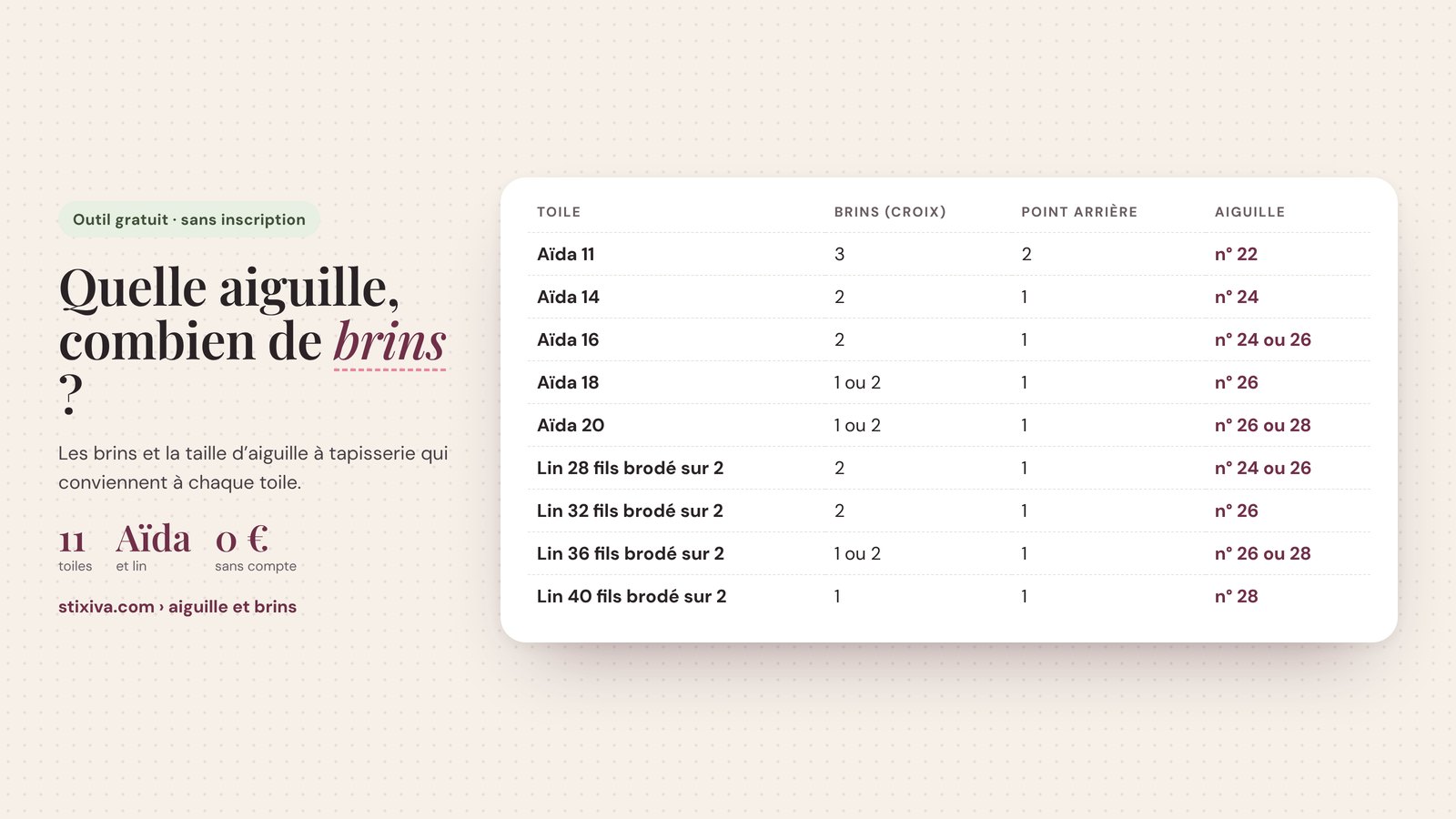
- One of the 6 threads that make up floss. On 14-count Aida, crosses are usually stitched with 2 strands and backstitch with just 1. See needle and strand count.
- Skein
- The small bundle of floss sold in craft stores, with a paper band showing the brand and color number. A DMC floss skein is 8 m (8.7 yards). The skein calculator tells you how many to buy.
- Color number
- The number that identifies a color within a brand: DMC 310 is black, DMC 321 a red. Numbers don’t match from one brand to another: you need a conversion chart.
- Color chart
- The catalog of all a brand’s colors, with their numbers. On screen, colors are approximate. See the online DMC color chart.
- Variegated floss
- Floss whose color changes along the strand, from one shade to another or from light to dark. Each cross takes the color of the piece of thread that stitches it.
- Blended threads
- Two strands of different colors in the same needle, to get an in-between shade or soften a gradient.
- Tapestry needle
- A needle with a blunt tip and a large eye, which goes through the fabric’s holes without splitting the threads. The higher the number, the finer it is: size 24 for 14-count Aida, size 26 for 18-count.
Stitches
- Cross stitch
- Two diagonal stitches crossing in the middle of a square. All the crosses in a project cross in the same direction, the second stitch always on top, for an even look.
- Half stitch
- Just one of the cross’s two stitches, on the diagonal. It’s used for shading, light backgrounds or large projects stitched faster.
- Quarter stitch
- A stitch from one corner of the square to its center. It rounds off curves and splits a square between two colors.
- Three-quarter stitch
- A half stitch plus a quarter stitch in the same square: half the square takes the color, the other half stays free for another color.
- Backstitch
- A straight stitch that follows the chart’s lines to draw an outline, fine lettering or a detail, once the crosses are stitched.
- French knot
- A small raised knot, made by wrapping the thread around the needle: an eye, a flower, the dot on an i.
- Petit point
- A diagonal stitch worked over a single fabric thread, finer than a cross stitched over 2: it allows very precise details, like a face.
- Blackwork
- Embroidery made only of backstitch, traditionally in black thread, forming geometric patterns and lacy fills.
Charts and patterns
- Pattern
- The design drawn on a grid: each square is one cross, and a symbol or color tells you which thread to use. A blank grid is for drawing your own design.
- Symbol
- The sign printed in the chart’s squares for each thread. It keeps the pattern readable even printed in black and white.
- Key
- The table that links each symbol to its thread: brand, color number, color name, number of strands and often number of skeins.
- Center of the design
- Marked by arrows at the edge of the chart. You often start stitching at the center of the fabric, found by folding it in four, so the design sits well.
- 10-stitch gridlines
- The thicker lines drawn every 10 squares on the chart, so you can count stitches without getting lost.
- PDF pattern
- The chart ready to print or follow on a tablet: chart pages with symbols, the thread key and often a color preview.
- Confetti
- Isolated stitches of one color in the middle of another, which make you change thread constantly. See how to avoid them.
- Parking method
- A way to stitch very colorful charts page by page: instead of ending a thread, you “park” it on the fabric where it will be needed next.
- Full coverage
- A project where the whole fabric is stitched, with no bare background: often a very colorful picture taken from an image.
- Photo to pattern
- Converting a photo into a cross stitch chart: the image is reduced to the chosen size and each square gets the closest thread. See how to turn an image into cross stitch.
- .oxs, .pat, .xsd
- Chart file formats: .oxs (open exchange format, Open Cross Stitch), .pat (PCStitch) and .xsd (Pattern Maker). They let you move a pattern from one program to another.
From theory to your own chart.
Draw your design or start from a photo: the studio makes the chart, the thread key and the PDF pattern.
Open the stixiva studio