COLORS & THREADS
DMC and Anchor color charts: browse, print and compare threads
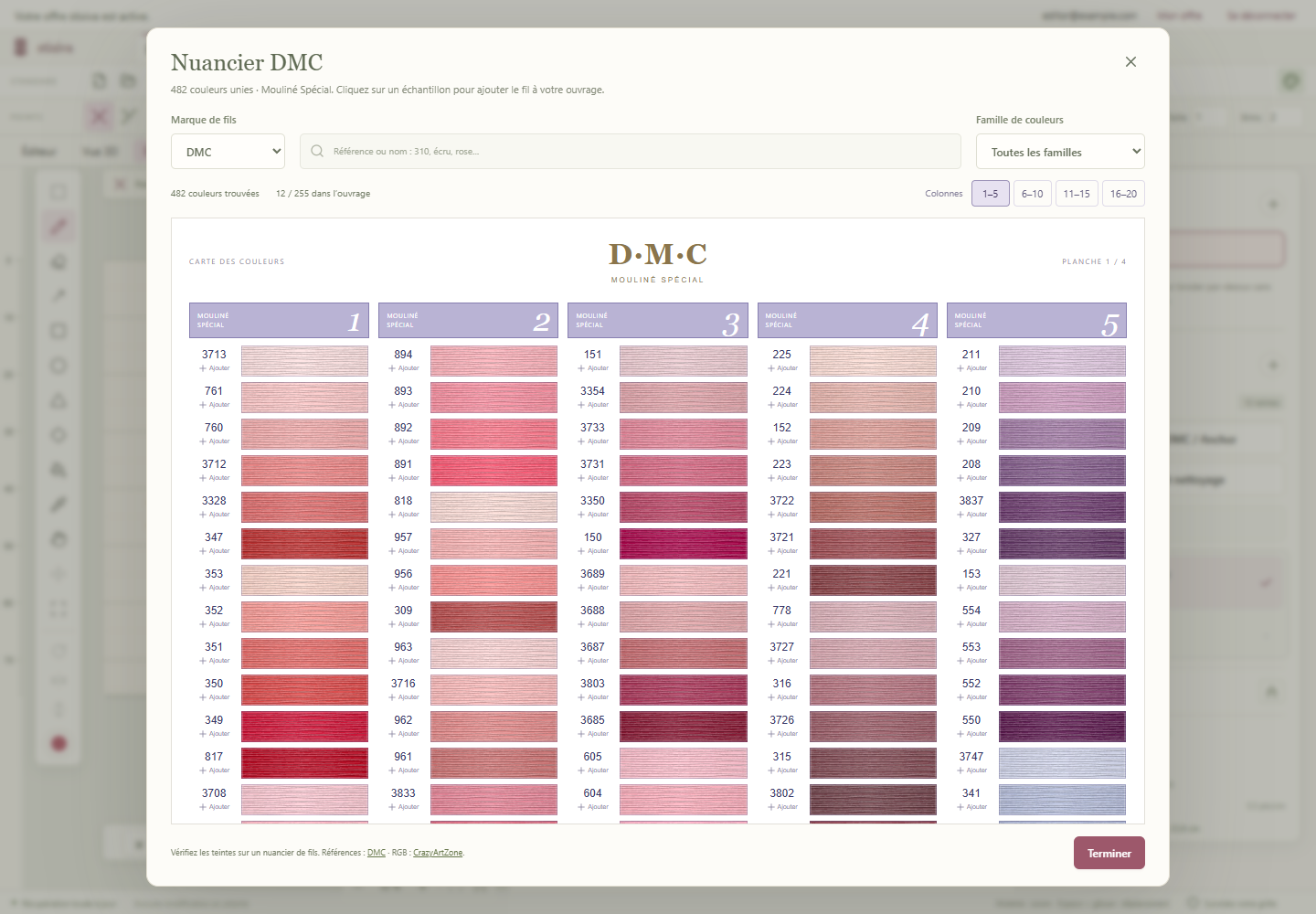
A thread color chart is the list of every color in a range, each with its number. On stixiva, the DMC (482 colors) and Anchor (444 colors) charts are free to browse online, by number, name or family, can be printed or downloaded as CSV for Excel, and each color has its own page with its equivalents in other brands.
- A floss number identifies a shade within one brand: DMC 310 and Anchor 310 are not the same color.
- The online DMC and Anchor color charts are free, printable and downloadable as CSV.
- On-screen colors are approximate: a real skein always has the final say.
- To switch brands, start from a conversion chart, then check in daylight.
How do you read a thread color chart?
Each line of a color chart links three pieces of information: the brand, the number (printed on the skein’s label) and the color, often with a name (“Black”, “Carmine red”). Cross stitch chart keys give this number next to each symbol: it’s what you look for at the craft store.
Numbers mean nothing from one brand to another. DMC and Anchor each number their shades their own way: the same number can mean two unrelated colors. So DMC 310 is a black, whileAnchor 310 is a very dark topaz (Anchor’s black is 403). So always note the brand with the number.
Why color charts are sorted by family
In a printed color card, shades are arranged by family (reds, blues, greens…) and from lightest to darkest, so you can compare neighbors at a glance. stixiva’s online charts follow the same principle: colors are grouped by family, and each thread page shows the closest shades from the same brand.
DMC or Anchor: what’s the difference?
Both brands make 6-strand cotton floss, sold in 8 m skeins. Their ranges are wide and cover most needs; they mainly differ in number of shades, numbering and availability near you.
| Criterion | DMC | Anchor |
|---|---|---|
| Range | Mouliné Spécial | Stranded Cotton Mouliné |
| Colors in the online chart | 482 | 444 |
| Skein | 8 m, 6 strands | 8 m, 6 strands |
| Numbering | DMC’s own (310, 321, B5200…) | Anchor’s own (403, 46, 1…) |
| Conversion table | DMC to Anchor | Anchor to DMC |
The best choice is often the brand already in your stash, or the one in your chart’s key: you avoid conversions. If you mix both, keep each brand to clearly separate areas of the project.
Printable DMC color chart, as PDF or for Excel
The online charts have two buttons: “Print”, for a paper version to keep next to your project (or to save as PDF from the print window), and “Download (CSV)”, a file that opens in Excel, LibreOffice or Google Sheets to sort threads or keep your inventory.
The chart’s “I have” and “I need” buttons work as an inventory: mark the threads you own, then show only the ones you’re missing before heading to the store.
A color chart printed on a home printer doesn’t show the threads’ real colors: it works as a list, not a color reference. To judge a color, nothing beats the skein itself or a color card with real thread.
Find a thread by number or by color
- By number : each thread has its own page, for example DMC 310 or Anchor 403, with its on-screen color, name and family.
- By name or family : the chart can be browsed by color family, from light to dark.
- By color : the floss color picker suggests the closest numbers to a photo or a color code, across several brands.
Converting an Anchor thread to DMC (and back)
There’s no formula that turns one number into another: each brand dyes its threads its own way. So we rely on conversion charts, which give the closest shade in the other brand for each thread. The Anchor to DMC and DMC to Anchor tables give them all at once, and the floss converter handles one number or a whole list, with Madeira and Sullivans too.
Each equivalent shows its on-screen color difference: below 2, the difference is barely visible. For large areas, still compare the skeins side by side in daylight. Our article DMC Anchor conversion explains the method.
Building a chart’s palette
You don’t need to keep every shade of a photo. In embroidery, colors are there first to separate shapes, suggest shadows and add accents. Several very similar digital shades can often be stitched with a single thread.
- Start with the dominant colors (background, skin, sky), then add shadows and highlights.
- Keep a visible gap between two neighboring shades, or they’ll merge once stitched.
- For a gradient, pick threads from the same family in the chart, from lightest to darkest; the floss gradient tool does it for you.
- For a harmonious palette, the color harmonies suggest threads that go together.
Preparing the thread list
- Write down every number in the key, with the brand.
- Note the number of stitches for each color: the large areas use the most thread.
- Estimate the skeins with the skein calculator, keeping a margin for the dominant colors.
- Cross off what you already have, and buy all the skeins of one color at once.
The printable thread list puts it all together. In the stixiva studio, the shopping list is calculated from the chart itself, with the DMC, Anchor, Madeira or Sullivans threads of your choice.
Our take
An online color chart doesn’t replace threads in your hand, but it saves precious time: finding a number, seeing its neighbors, preparing a list or an inventory. We chose to show the source of every on-screen color and every equivalent, rather than presenting them as exact, so you stay in control of the final choice.
FAQ
Where can I find a free DMC color chart?
stixiva’s DMC color chart is free and online: its 482 colors can be browsed by number, name or family, printed or downloaded as CSV, no sign-up.
Is the DMC color chart available as a PDF or for Excel?
The chart’s “Print” button also lets you save it as a PDF from the print window. The “Download (CSV)” button gives a file that opens in Excel, LibreOffice or Google Sheets.
Are DMC 310 and Anchor 310 the same color?
No: each brand has its own numbering. DMC 310 is a black, Anchor 310 a very dark topaz. Always note the brand with the number.
What is the DMC equivalent of an Anchor thread?
The Anchor to DMC table gives the equivalent of each of the 444 Anchor threads, and the floss converter handles one number or a whole list. Then check the shade in daylight.
Are the colors in an online color chart accurate?
No, they’re approximate: a screen never shows a thread exactly, and dye lots vary. Compare with a real skein before buying.
Does pearl cotton use the same color chart as stranded floss?
stixiva’s online color charts cover stranded floss. Pearl cotton is a different thread with its own range: check the manufacturer’s color card to make sure the shade you want exists.
Sources
- DMC Mouliné Spécial (manufacturer’s page); on-screen colors based on CrazyArtZone.
- Anchor Stranded Cotton Mouliné (manufacturer’s page); on-screen colors based on Stitchfully.
- DMC to Anchor conversion: find a thread’s equivalent (stixiva blog, in French).
Build a palette that’s ready to stitch.
Explore your design’s colors and prepare your chart in the studio.
Open stixiva